The core infrastructure is implemented: durable ingestion, background
recovery, structured data, search, calculated key figures, latest
values, tick history, OHLC candles, corporate-action consolidation,
split adjustment, durable observation tasks, and typed SDKs. We build
on that foundation to implement the provider-specific parsers and
integrations your product needs.
Evidence reviewed 15 September 2026. Early customer evaluation; no
customer production references are published here.
01 / THE DATA MODEL
A Dataset defines what you cover.
Which entities do you have information about, and what can your
product do with it? A Dataset brings together a Catalog and,
optionally, one canonical Stream for the entities it covers. The
Catalog describes those entries; the Stream carries their time-ordered
updates.
Each Dataset has its own coverage: a broad instrument universe, a
venue’s listings, or a specialist set of structured-product terms.
Coverage is actual membership—not a category label, and not a promise
that every field or historical period is populated.
Catalog — Model the things your product needs to understand.
A Catalog holds structured records: instruments, listings,
issuers, financial observations, classifications, and
relationships. Define typed fields, identifiers, and dimensions
around your data. Combine provider information with your own
fields while retaining provenance and access requirements.
Instruments and listings: identifiers, names,
currencies, venues, and product terms.
Companies and issuers: legal entities,
classifications, and issuer relationships.
Fundamentals and estimates: observations
organized by subject, metric, period, and provider.
Analyst data: structured ratings, price
targets, and recommendations.
Funds: holdings and constituent records linking
funds to instruments.
Corporate actions: dated events, split ratios,
statuses, and distributions.
A Catalog is not a fixed instrument schema or a static file. Its
records change as information arrives; your schema defines what
those records mean.
Stream — Model what happens over time.
A Stream carries a source-ordered sequence of typed updates:
quotes, trades, or other changing values. Your schema defines the
payload. OpenMDTA supplies live delivery, retained history,
explicit gaps, and recovery around it.
Source positions make continuity explicit. Live processing
continues alongside background recovery; recovered history does
not overwrite newer live state. Anything still missing remains
visible.
For example, a Catalog describes an instrument and its listings. A
Stream carries quote and trade updates. Services expose the
current values, individual historical ticks, and aggregated
candles.
The distinction is how you model and consume information—not
simply “slow data” versus “fast data.” A Catalog-only Dataset can
provide specialist information without a live Stream.
Data coverage and financial logic
These are modeling examples, not bundled datasets. Provider
integration, reporting periods, revisions, and financial semantics
need defining for your use case. Holding ETF constituent data is not
the same as implementing complete recursive look-through
calculations.
News ingestion, archiving, and delivery are outside the current core
offering.
OpenMDTA supplies a platform for organizing, calculating, searching,
and distributing data—not a bundled financial-data subscription or a
complete Terminal replacement. Coverage comes from the data you own
or license and the integrations we implement together.
02 / CONNECT THE IDENTIFIERS
Different identifiers. The same entity.
One provider uses an ISIN, another a WKN, a third its own identifier.
Connect their information through shared identity resolution instead
of rebuilding cross-provider mapping tables in every application.
Typed identifiers. Traceable connections.
Identifiers carry their type: ISIN(…),
WKN(…), CUSIP(…), or a configured
vendor-specific type—not an unexplained string. Source records
assert which identifiers refer to the same entity. Identity
resolution connects those claims within the appropriate entity
type and selects a leading identifier using configured priorities.
Alternative identifiers and contributing source records remain
available. Your product gets a common reference without discarding
provider IDs or rewriting authoritative source data. An issuer’s
LEI identifies a legal entity, not the instrument it issued.
Same instrument does not mean same listing.
An instrument can have several trading lines. Keep its identity
separate from venue, currency, and other source-defined
dimensions. Resolve the instrument, then filter the selected
Catalog’s records for the trading context your product needs. A
lookup can return several records; even ISIN, MIC, and currency
are not universally sufficient to identify one listing.
When you need one exact source record, address it by
{catalog, record_key}. Its key stays source-owned—not
a universal instrument ID or a vendor-independent listing ID.
Identity connects. Coverage tells you what is available.
Knowing that two identifiers refer to the same instrument does not
mean every Dataset contains it. Combine identity resolution with
remixed Dataset coverage to join provider
information, discover specialist data, and offer the right product
features for that entity.
Changing claims, priorities, and exact references
Resolution uses source-supplied claims and configured policies, not
name matching or an assumed global identifier table. Source updates
and withdrawals recompute affected mappings; downstream remixers
follow the published Identity Catalog. Conflicts and rebalances
remain inspectable.
A leading identifier can change as claims or priorities change; it
is not a promised permanent ID. Exact source-record references also
require handling missing or reused keys. Mapping establishes neither
data completeness nor access rights.
03 / REMIX YOUR UNIVERSE
Your main Dataset. A map to everything else.
Remixing is how you build the Dataset your product starts from: the
entities you cover, the information you bring together, and the
specialist data your users can explore next.
Define your universe. Enrich it your way.
Choose which input Datasets determine membership in your main
Dataset. Resolve their records to shared entities, combine fields
with your own source priorities and rules, and enrich them from
other inputs. Remixing materializes the resulting Catalog and
updates affected entities as inputs change, retaining provenance
and access requirements.
Discover coverage. Offer the right next step.
Publish a per-entity overview of membership in configured input
Catalogs, including their record keys and lifecycle state. Track a
specialist Dataset’s coverage without copying all its fields into
your main model. Your product can discover which additional
Datasets cover an entity and link to their information.
A useful link—not an empty section.
Two instruments may both be classified as
STRUC_PRODUCT. Only one is covered by your
structured-products masterdata Dataset. Show the “Structured-product
details” link for that instrument—not for every instrument with the
same category. Base the link on actual Dataset membership and the
user’s access, with the lifecycle state appropriate to your product.
04 / THE SERVICES
One Gateway. Purpose-built services.
Your team builds against one interface.
The Gateway brings the services together behind one customer-facing
interface. It authenticates requests, applies access rules, and
routes them to the right service. Your developers use a consistent,
schema-generated SDK for structured records, current values,
history, and calculated figures—not a separate integration for every
service.
Your datasets and services, in one place.
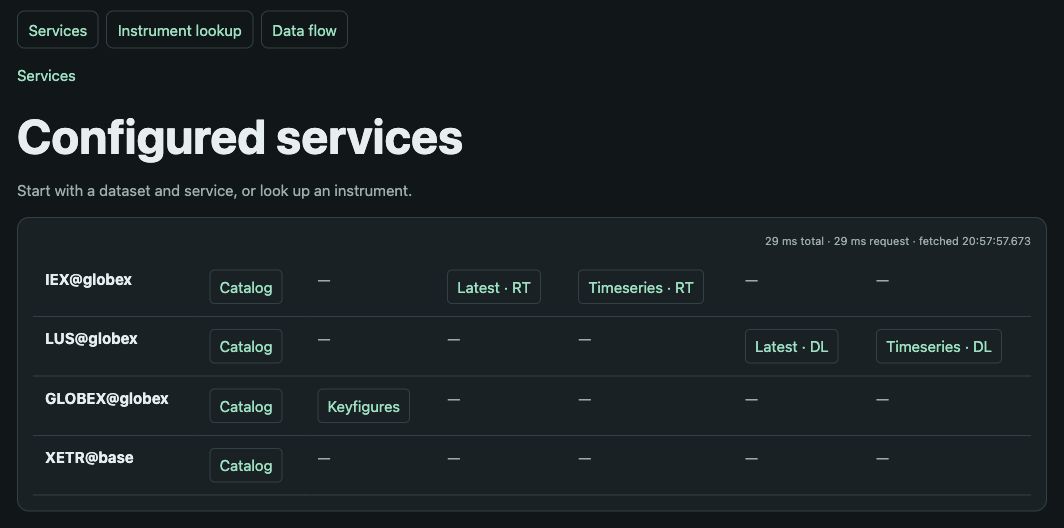
The built-in Explorer lists datasets and their configured services.
Actual screenshot from our local evaluation deployment—not a service
health dashboard or a catalogue of bundled data rights. Click to
view full size.
READER / CATALOG ACCESS
Find and retrieve your structured data.
Turn a Catalog into a usable application interface. Retrieve
selected fields, look up records by keys or identifying
dimensions, and expose configured search and discovery
capabilities.
Record and field retrieval; identity-aware lookup through the
platform.
Autocomplete, text search, facets, and numeric filters.
Configured search projections and access rules.
Build an instrument finder, an issuer profile, or a searchable
fundamentals dataset.
LAST / LATEST VALUES
The current picture, continuously updated.
Read the latest available values, then follow updates through a
subscription. Shared upstream processing serves multiple consumers
without duplicating the entire ingestion path.
Current snapshots followed by typed updates—not just the last
traded price.
Applicable real-time, delayed, and end-of-day delivery policies.
Continuity and gap information alongside the data.
Build a watchlist, a quote page, or a customer-facing live API.
TIMESERIES / HISTORY & AGGREGATION
Tick history and OHLC. Built to scale.
Query individual historical observations and open/high/low/close
candles on the same platform. Partitioned storage, compressed
pages, and indexed range reads keep queries focused on the data
they need.
Tick-level history, OHLC aggregation, historical queries, and
live-following interfaces.
Explicit coverage and gaps; supported intervals follow the
configured model.
Separate query and materialization workers: add serving capacity
without repeating historical processing.
Build charts, historical analysis, or a vendor’s historical-data
API.
KEYFIGURES / CALCULATIONS & SCREENING
Turn data into useful calculations.
Combine Catalog information with selected price inputs. Define
calculation logic and expose results for individual instruments or
searchable result sets.
Configurable calculations, input selection, and derived numeric
values.
Filtering, sorting, and screening with price-freshness,
availability, and access policies.
Midpoint and spread are implemented examples; additional
financial formulas and their inputs are scoped separately.
Build a product screener or a customer-specific calculated
dataset.
OBSERVATION / WATCHES & TRIGGERS
Turn changing data into useful notifications.
Build persistent watches around the conditions your users care
about.
Durable task state, trigger transitions, and protection against
rapidly oscillating conditions.
Task state and pending notifications committed together;
delivery retries use a durable outbox.
Historical recovery produces separate summaries, not misleading
live alerts, and does not overwrite the current live state.
Your application supplies instrument resolution, typed rules, and
notification delivery. The reusable core is implemented; a
ready-made Gateway observation API or email/push integration is
not implied.
Build price alerts, threshold watches, or customer-specific
notifications that bring users back at the right moment.
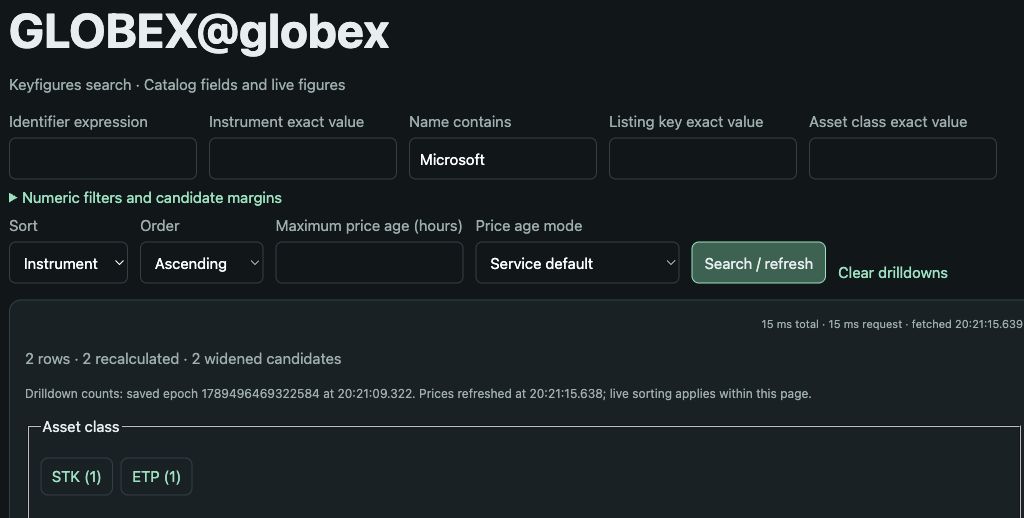
Search and discover in the built-in Explorer.
Name search and asset-class facets in the Keyfigures view of our
local evaluation deployment. Actual screenshot, cropped to the
search controls; no quote values are shown. Click to view full size.
Corporate actions. Consolidated and applied.
Consolidate dated corporate actions and distributions across sources
with deterministic source priorities and retained provenance.
Request raw values or opt into split adjustment through the Gateway
for supported snapshot, live, and time-series fields. Confirmed
split ratios adjust prices and quantities at delivery; stored source
data stays unchanged.
Raw is the default. Distributions are modeled and consolidated, but
are not yet applied as a total-return adjustment. Feed coverage and
the financial rules required by your product remain part of the
integration scope.
Delivery semantics and integration boundaries
Catalog import cursors advance after writes complete; replayed
writes are idempotent. Immutable payloads precede manifest
publication. These are scoped semantics, not a blanket exactly-once
promise. Ordering is source-local; SDK reconnect delivery is at
least once. Clients handle gaps and replacement values according to
the selected API contract.
Catalog search exposes a configured projection to holders of its
search grant; per-record detail permissions do not filter that
projection. Review its fields before enabling it. Keyfigures search
checks the caller’s permitted inputs before returning results.
Search freshness and ranking follow the selected service’s contract;
there is no universal guarantee of exact global live ranking.
05 / CONNECT
Your feeds. On a shared foundation.
You should choose feeds for your product—not to fit our connector
list. We implement or adapt the parsers, protocol handling, and
mappings for the providers you need, using the shared ingestion,
recovery, storage, and delivery infrastructure already in place. Your
pilot defines the exact interfaces and the integration work still
required.
Explore existing adapters and test sources
Starting points with local automated test coverage—not the limit of
what we can integrate, or a claim of production certification.
Implemented interfaces — local test coverage, not production
certification
Source
Interface & scope
Important boundary
Synthetic quote source (SIM)
Configurable instrument count and messages per second,
independently per simulated venue.
Repeatable integration and load tests without vendor market
data. The configured rate is requested load, not a measured
throughput guarantee.
IEX
TOPS protocol decoding and replay; source integration with a
compatible endpoint.
Development replay and protocol tests. No claim of certified
live exchange connectivity.
Xetra
All-tradable-instruments semicolon-delimited full file over
HTTP.
Reference data, not an order-book feed. Column and venue
validation.
ESMA FIRDS
Full and delta publications; ZIP/XML ingestion.
Publication completeness and cursor handling; not a
corporate-action engine.
GLEIF
LEI2 Golden Copy full and delta ingestion.
Legal-entity reference data, not market prices.
OpenFIGI
Identity-driven HTTP mapping API worker.
Identifier enrichment, not a price feed or a universal
identity guarantee.
06 / ENGINEERING TARGET
Two million instruments. One fast CPU core.
Our goal: handle a feed of 2 million instruments at 200,000
updates per second, including ingestion, latest-state maintenance,
and time-series processing, on one fast CPU core.
Only the separate S3 storage server’s resources are excluded.
OpenMDTA’s encoding, compression, and client-side storage work
remain in scope.
Engineering target—not a measured end-to-end result or an
SLA.
Hardware, payloads, persistence settings, and recovery load must be
specified and measured before claiming this target is met.
07 / BUILD
Typed data. Familiar code.
Schema-generated SDKs carry your fields into your developers’
workflow. This example from our generated Globex SDK reads a quote
sample with typed bid/ask, trade, and custom fields. Exchange messages
stay grouped; prices remain exact decimal strings.
import { connect, selector, type ConnectOptions } from "@globex/market-data";

export async function readQuoteSample(options: ConnectOptions, symbol: string) {
  const connection = await connect(options);
  try {
    const requested = selector.us(symbol).at("IEX");
    const result = [];
    for await (const msg of connection.stream({
      selector: requested,
      blocks: ["BidAsk", "Trade", "ClientTradeAttributes"],
    })) {
      if (msg.selector !== requested) throw new Error("response belongs to another selector");
      console.log("yes, it is what we requested");
      result.push({
        phase: msg.phase,
        requestedSelector: msg.selector.expression,
        sourceRecord: msg.sourceRecord,
        messageId: msg.messageId.toString(),
        bid: msg.fields.bidAsk?.bid?.price.toString() ?? null,
        ask: msg.fields.bidAsk?.ask?.price.toString() ?? null,
        trade: msg.fields.trade?.price.toString() ?? null,
        clientTradeAttributes: msg.fields.clientTradeAttributes ?? null,
        presentFields: [...msg.fieldIterator()].map((field) => field.name),
      });
      if (result.length === 2) break;
    }
    return result;
  } finally {
    await connection.close();
  }
}
08 / OPERATE
Durable storage. Replaceable services.
OpenMDTA’s durable state lives in S3-compatible storage, not in an
irreplaceable service instance. Restart or replace services, reconnect
them to the same storage, and resume from persisted state. Reliable
storage is the foundation of recovery—without an OpenMDTA-specific
backup-and-restore procedure for each service.
Keep deployment configuration and credentials available independently.
Storage must provide the required consistency and conditional-write
semantics; availability, retention, and data protection remain part of
the deployment design.
Access & isolation
Data credentials implement scoped grants, audience/origin checks,
and limited lifetime. Deployment isolation, key management, and
network controls need an agreed configuration and review. No
independent penetration-test report, security certification, or
audited tenant-isolation guarantee is published here.
Continuity & visibility
Explicit gaps and replay mechanisms are implementation features.
Multi-region HA, storage disaster recovery, restart times,
stale-data monitoring, reconciliation, and bad-tick handling must
be demonstrated for the deployment. No public SLA or 24/7 support
coverage is promised.
Rights & provenance
Connectors do not grant exchange or vendor data rights. Agree
permitted use, redistribution, and entitlements before connecting
licensed data. Code provenance, dependency licenses, and
commercialization evidence belong in the technical and contractual
review; this page is not a legal clearance statement.
Control & handover
Choose the operating model that fits your team:
We run it on our infrastructure. We provide the
environment and operate OpenMDTA.
We run it on your infrastructure. We operate
OpenMDTA in your environment with agreed access and
responsibilities.
You run it on your infrastructure. Your team
handles deployment and operations, with optional integration and
support from us.
Define data export, configuration portability, source access,
operating documentation, and handover tests before commitment.
Source escrow is not promised.
Our goal: independence you can demonstrate.
Give an external engineering team only the public repositories and
documentation. Can they build, deploy, ingest a feed, generate an
SDK, redeploy services against existing storage, upgrade, and
operate the system without contacting OpenMDTA? That is our
acceptance test for independent self-hosting.
A goal, not a completed validation. This does not
announce a public repository release or claim that a team has passed
the test. Required infrastructure and feed permissions remain the
operator’s responsibility.